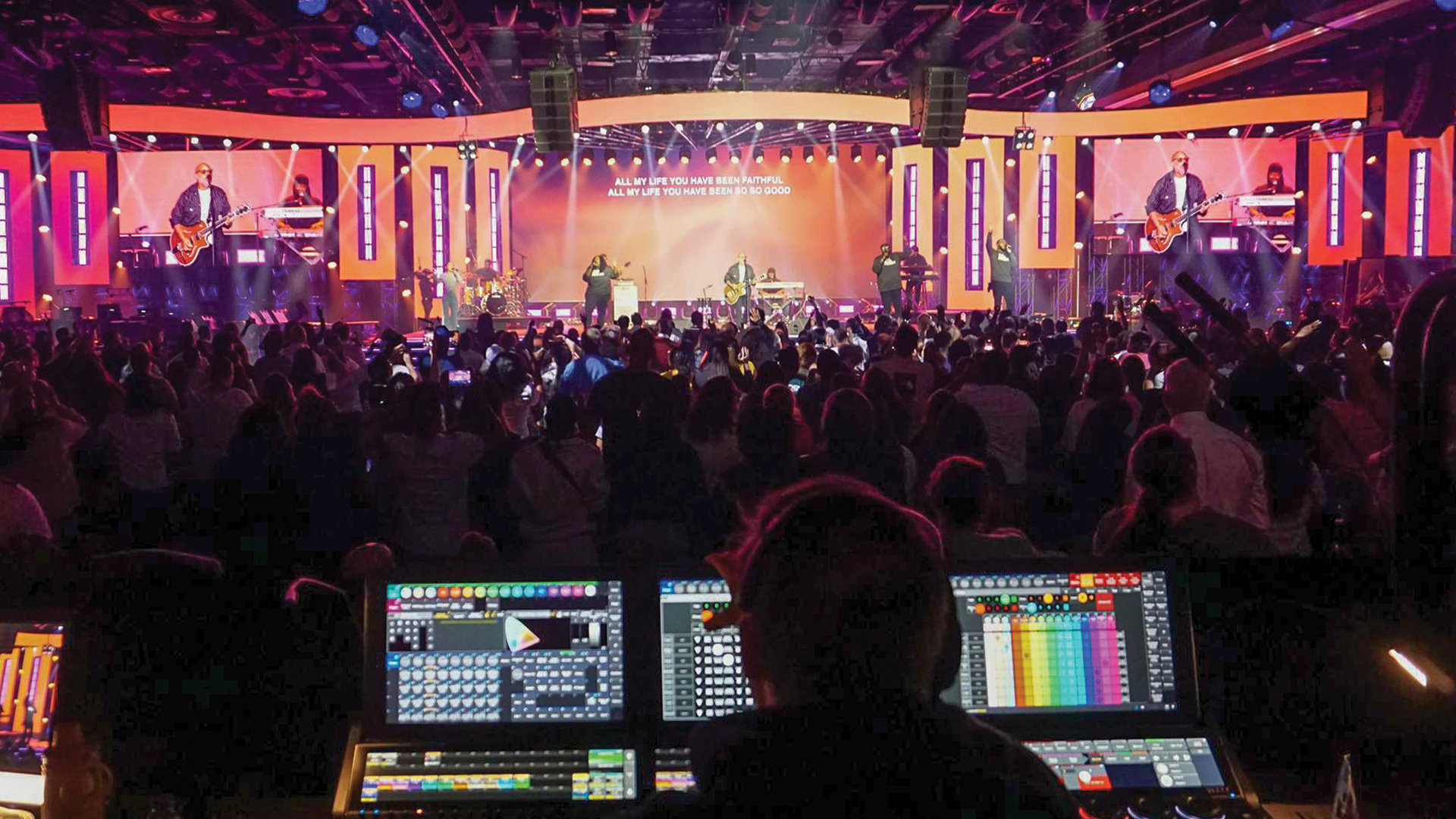
In live video production, there is no edit suite, no second take, and no safety net below the moment of output. When the CEO steps to the podium and the operator calls for a video switcher transition, that cut either happens cleanly or it doesn’t — and in a world of livestreamed general sessions, hybrid events, and IMAG screens the size of buildings, it doesn’t is no longer an acceptable outcome. The professional answer to this reality is not better luck or faster reflexes. It is redundant switching architecture — a signal flow design philosophy that eliminates single points of failure from the video production chain through the deliberate deployment of parallel systems, each capable of sustaining full output if its counterpart fails.
A Brief History of Video Switching in Live Events
The discipline of live video production switching traces its roots to broadcast television, where production switchers first appeared in the late 1940s and early 1950s. Early live television from NBC and CBS used mechanical switching systems — quite literally physical connections being made and broken between camera feeds. By the 1970s, production switchers had evolved into sophisticated analog electronic systems with mix-effects banks, downstream keyers, and the fundamental transition vocabulary — cuts, dissolves, wipes — that persists to this day. The Sony BVS series and Ross Video Synergy switchers of the 1980s and 1990s became workhorses of the broadcast and corporate AV markets. The transition to IP-based video production in the 2010s, with standards like SMPTE ST 2110 and NDI (Network Device Interface) reshaping how signals flow through production systems, created both new redundancy opportunities and new failure modes.
Understanding Single Points of Failure
Before designing a redundant switching system, map every single point of failure (SPOF) in your existing video chain. A SPOF is any component whose failure causes total loss of output with no automatic or rapid manual recovery path. In a conventional event video system, SPOFs typically include: the primary production switcher, the multiviewer driving the director’s monitoring, the frame synchronizer or genlock reference, the media playback server feeding pre-produced content, and the signal distribution amplifiers feeding the LED processor or projector. Any one of these components failing at the wrong moment turns a professional event into a crisis.
The Redundant Switcher Architecture
The most common approach to production switcher redundancy is a primary/backup switcher pair — two identical (or functionally equivalent) switchers running in parallel, both receiving the same input feeds, both loaded with identical show files and settings, with a hardware or software mechanism to select between their outputs. Platforms well-suited to this topology include the Grass Valley Karrera and Korona, the Ross Video Acuity, the Blackmagic Design ATEM Constellation series, and the Sony XVS series. The selection mechanism between primary and backup outputs is typically a downstream video signal router or a presentation switcher
like the Analog Way Aquilon RS4 or Barco E2 — devices specifically engineered for seamless source switching with frame-accurate transitions. The critical requirement is that the switchover between primary and backup must be glitch-free — a frame-synchronized cut that the audience and broadcast feed never perceive as a failure event.
Presentation Switcher as the Integration Hub
In contemporary large-format corporate production, the presentation switcher has evolved from a simple source selector into the central intelligence of the video signal flow. Systems like the Analog Way Aquilon, Barco E2 / S3, Christie Spyder X80, and disguise media servers function as multi-layer compositing environments that accept dozens of simultaneous inputs, apply real-time scaling and positioning, and output to multiple destinations simultaneously. Redundancy in these systems is built around dual power supply modules, redundant processing boards, and in the case of disguise, the Director/Performer architecture that enables automatic failover between processing nodes without operator intervention.
Signal Timing and Frame Synchronization
Redundant switching only works cleanly when all signal sources are frame-synchronized — locked to the same timing reference so that switching between them produces a clean, artifact-free transition. In SDI-based systems, this means a distributed Black Burst or Tri-Level Sync reference fed to all sources and switchers. In IP-based systems using SMPTE ST 2110, PTP (Precision Time Protocol) provides the nanosecond-accurate timing synchronization that enables seamless switching. Failure to establish proper genlock synchronization across the redundant system is the most common cause of glitchy failover transitions that defeat the entire purpose of the redundancy investment.
Backup Media Playback: The Other Half of the Equation
Production switcher redundancy is only meaningful if the media playback sources feeding it are equally protected. A redundant switcher with a single media server provides no protection against the most common failure mode: the playback system crashing or stalling on a video file. Run dual media servers — whether disguise, Renewed Vision ProPresenter, Dataton Watchout, or Resolume — in synchronized hot-standby mode, with the presentation switcher positioned downstream of both servers to enable instant source selection. Rehearse the failover procedure with the entire video team — a switchover that requires 30 seconds of confused operator communication during a live show is not a redundancy system; it is a delayed crisis.
Pre-Show Redundancy Verification
Every redundant system requires a pre-show verification protocol that actively tests the failover path, not merely confirms that both systems are powered on. During pre-show checks, deliberately switch from primary to backup — confirm the output at the LED processor or projector is clean, confirm monitoring continuity, confirm that backup system state matches primary. Then restore primary and repeat the test in the opposite direction. A redundancy system that has never been tested under show conditions is theoretical protection — and theoretical protection has a habit of failing at the worst possible moment.
