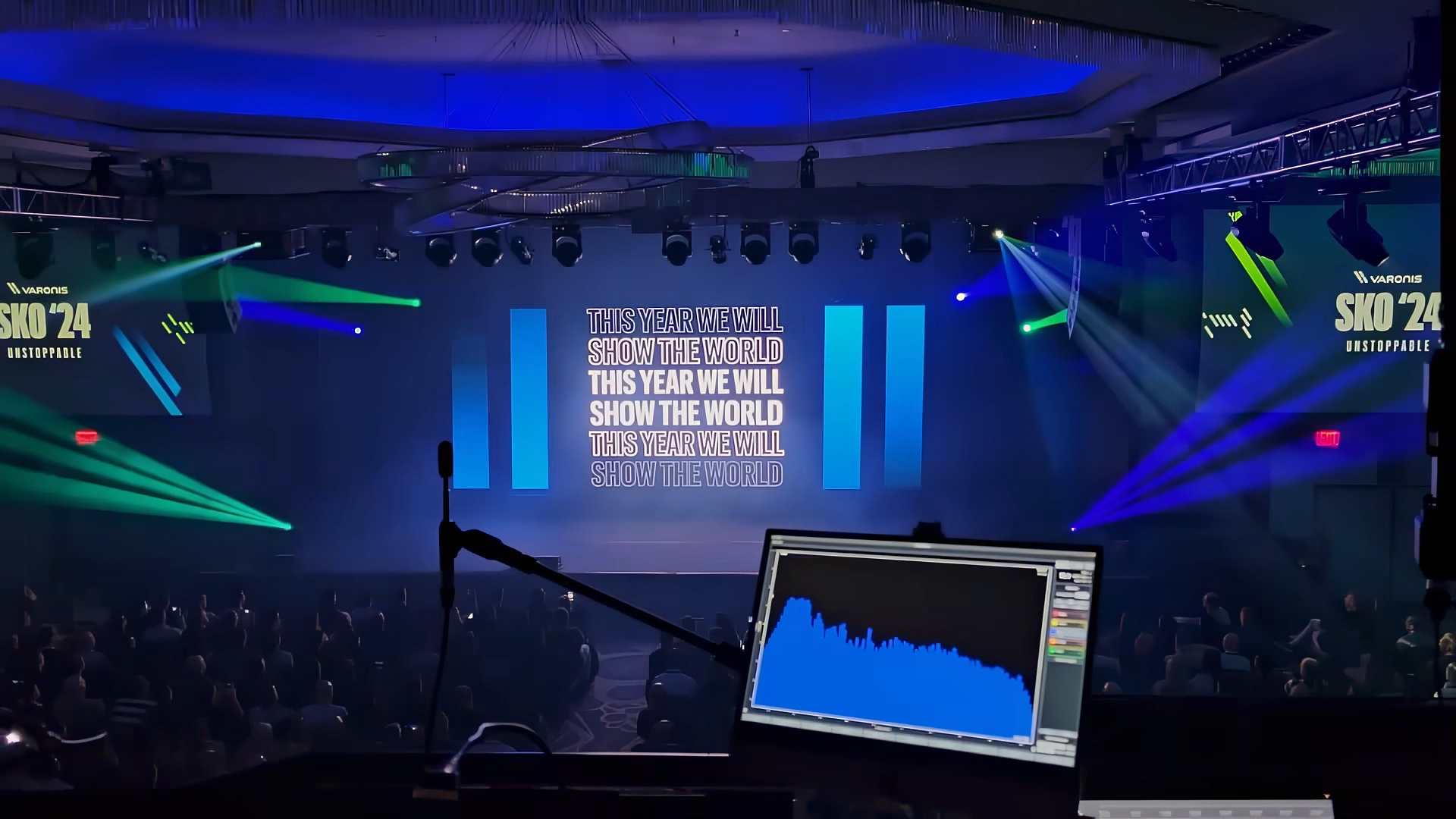
The single-plane LED wall has dominated corporate event staging for over a decade. It is effective, scalable, and understood by clients whose frame of reference is the cinema screen. But the productions that genuinely move audiences—that transform a corporate keynote from a presentation into an experience—almost universally deploy some form of visual layering: multiple planes of LED or transparent display material creating a spatial depth that a single-surface display cannot achieve.
The principle draws directly from theatrical scenic design. A stage with a backdrop, a mid-ground element, and a foreground piece has inherent depth because each layer occupies a different z-plane in the audience’s visual perception. When each of those layers is a controllable LED surface, the designer gains the ability to tell stories across spatial dimensions rather than within a single surface—creating a visual language of depth, reveal, and dimensional transition that audiences experience viscerally rather than intellectually.
The adoption of layering techniques in corporate event production has accelerated dramatically since 2018, driven by the availability of transparent LED mesh products from manufacturers like Absen, ROE Visual, and Glux, and by the media server software—specifically Disguise and Resolume Avenue—capable of mapping content across multi-surface configurations with frame-accurate precision.
Transparent LED: The Game-Changing Material
Transparent LED mesh—a lattice structure of LED nodes suspended in a mesh framework with 70–90% light transparency—enables a layering approach impossible with conventional LED panels. Suspended downstage of a solid LED wall, a transparent mesh layer allows the rear wall to show through while displaying its own independent content layer, creating a foreground visual plane that appears to float in space rather than exist on a surface.
ROE Visual’s Black Marble transparent panels and Absen’s Cobalt series are among the most specified products in this category. With pixel pitches in the 5–10mm range—coarser than solid panels but sufficient for graphical and atmospheric content at typical corporate viewing distances—transparent LED allows content designers to work with motion layers that interact visually with the solid wall content behind them, creating the illusion of dimensional motion as foreground elements pass across the background wall.
The production challenge of transparent LED is lighting contamination: because the mesh transmits a significant percentage of incident light, stage lighting falling on the transparent layer also illuminates the solid wall behind it, potentially washing out the rear wall content. Productions using transparent LED must develop a lighting design that works with this interaction rather than against it—typically using very selective, low-angle downstage lighting that illuminates performers without creating the broad wash that would compromise the layered visual system.
Multi-Surface Content Mapping With Disguise
The technical architecture for a multi-layer LED wall system almost always centers on a Disguise media server. The gx 2c and gx 3c systems, with their high-output NVIDIA GPU configurations, provide the processing power needed to drive multiple independent high-resolution output streams while maintaining frame-synchronization between them—a requirement that prevents the visual tearing that occurs when independent media servers attempt to synchronize without a hardware timing reference.
Disguise’s Stage object workflow—where each LED surface is defined as a three-dimensional object in the virtual space that mirrors the physical stage layout—enables content creators working in the Disguise designer environment to build media in the correct spatial context from the outset. A content animator creating a transition where graphics appear to emerge from the rear solid wall and travel through the transparent foreground layer can preview this behavior in Disguise’s 3D visualization mode before the physical installation exists, avoiding the expensive on-site content adjustments that plagued early layered productions.
The mapping precision of the Disguise system is particularly critical for the reveal technique: a corporate production moment where a product or executive appears to emerge from the LED surface as physical scenic elements part to reveal the human or object they had been concealing. Achieving this effect requires sub-pixel-accurate alignment between the LED content and the physical position of the scenic element, accomplished through Disguise’s output warping and blend zone features that compensate for physical installation imprecision with digital correction.
Depth Without Technology: Scenic Integration Techniques
Not every layering technique requires multiple active LED surfaces. Experienced corporate event designers achieve dimensional depth by integrating LED wall content with physical scenic layers—set pieces, architectural structures, product displays, and performer blocking—that create visual depth through contrast with the two-dimensional LED surface rather than through additional display technology.
The most effective approach places high-contrast scenic elements at various stage depths, using the LED wall as a dynamic backdrop that responds to—and contextualizes—the physical foreground. A product launch where the physical product sits on a rotating plinth at centre stage, surrounded by LED pillars and backed by a curved LED wall, creates three distinct visual planes without requiring any transparent display technology: product (foreground), LED pillars (mid-ground), and LED wall (background).
Haze and atmosphere play a critical supporting role in depth perception for layered LED productions. Atmospheric haze—produced by MDG Atmosphere generators or High End Systems HazeBase—makes light visible in space, allowing the beams from lighting fixtures to create additional virtual layers between the scenic planes. In a production with LED wall layering, a haze layer between the transparent foreground mesh and the solid rear wall adds a luminous visual stratum that enhances the perception of spatial depth while softening the transition between content layers.
The Brand Language Dimension
For corporate event producers, LED wall layering is ultimately a storytelling tool whose primary function is brand communication. The most sophisticated deployments use layering not for visual spectacle but for narrative architecture—creating visual environments where the spatial relationship between content layers reinforces the thematic structure of the presentation.
A technology company announcing a new platform architecture might deploy a layered LED system where the rear wall displays the abstracted data infrastructure—rendered as flowing particles or network graph visualizations—while the transparent foreground layer carries the human-facing interface elements that rest “above” the infrastructure, visually communicating the software layer model as spatial metaphor. The CEO presenting at the foreground of this environment is physically positioned within the narrative architecture, standing between the infrastructure layer and the interface layer.
This level of intentional narrative design requires close collaboration between the creative director, the content team, the lighting designer, and the LED technical director from the earliest stages of event planning. Productions that bolt layering onto existing stage designs as an aesthetic upgrade rarely achieve the narrative impact available to those that build the layered architecture as the foundation of the event’s visual story from the outset.
