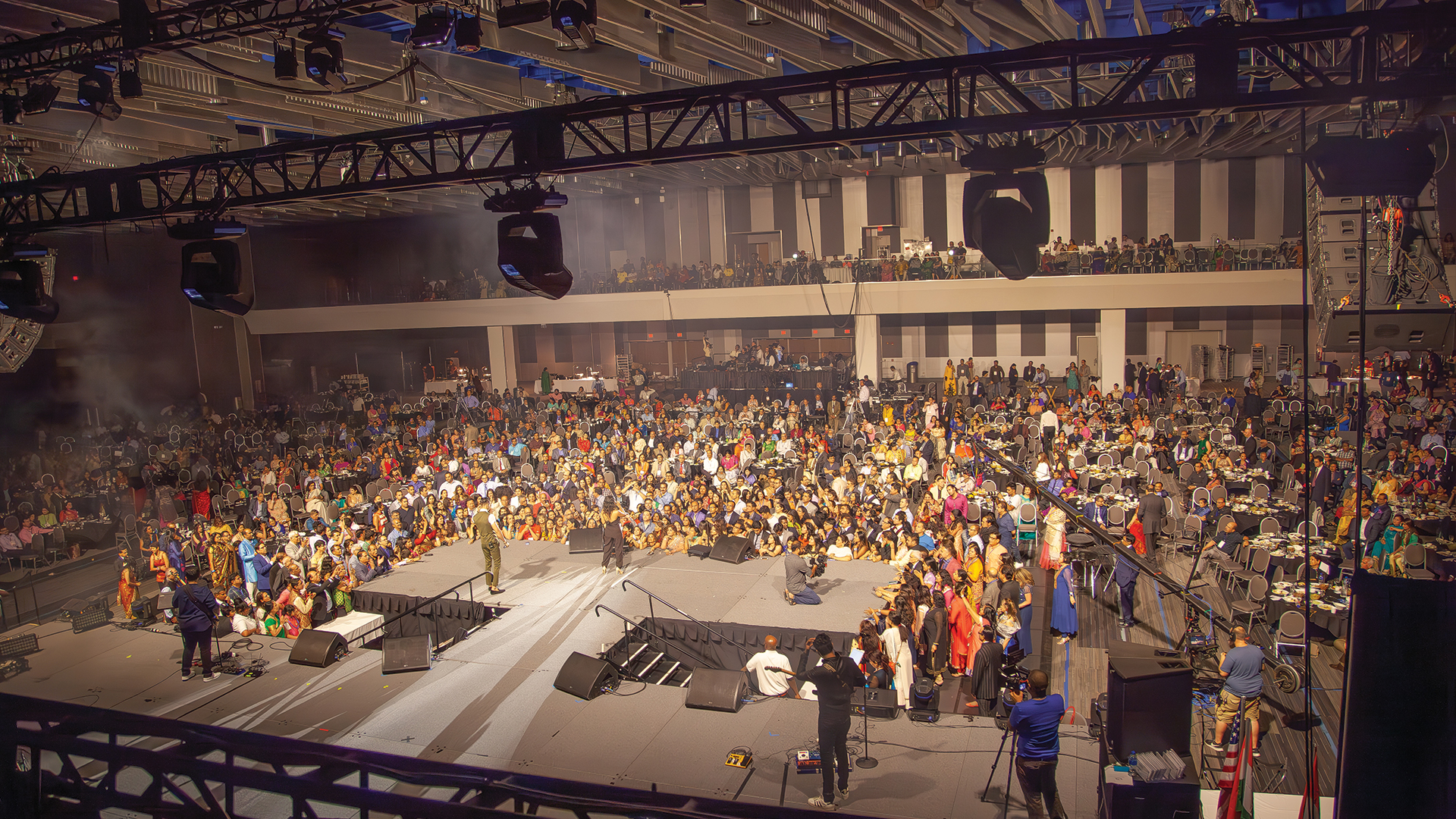
Color theory in stage and event lighting design is not the same discipline as color theory in visual arts — though it begins there. Where a painter mixes pigments governed by subtractive color mixing, a lighting designer combines light sources governed by additive color mixing, and the rules are fundamentally different. A stage lighting designer is building a dynamic environment that must read consistently across a live audience, HD broadcast cameras, still photography, and the subjective experience of the performers. Getting color right requires a working command of spectral physics, perceptual psychology, and the specific capabilities of modern RGB, CMY, and RGBW LED systems.
Additive vs. Subtractive: The Foundational Distinction
Pigment mixing is subtractive: each pigment absorbs wavelengths from the spectrum, and combining pigments reduces the available reflected light. Light mixing is additive: combining red, green, and blue light sources produces white light at full intensity. This means that a lighting designer using Lee Filters, Rosco gels, or CMY dichroic color mixing in moving fixtures is working in a physical substrate that behaves differently from what most general color education teaches. Understanding this prevents the chronic mistake of attempting to apply pigment-based color relationships to a light-mixing environment.
Color Temperature and Its Perceptual Effect
Color temperature, measured in Kelvin, describes the spectral character of a white light source. 3200K tungsten, historically the standard for entertainment luminaires, produces warm, amber-rich light. 5600K daylight is the standard for outdoor and broadcast lighting — blue-weighted, crisply neutral. Stage lighting designers exploit these associations deliberately — shifting a grandMA3 cuelist from 3200K to 5600K white over 30 seconds can transition an audience’s subconscious reading of the scene from intimate to exposed without a single physical scenic change.
The HSB Model in Practice
Working lighting designers think in Hue, Saturation, and Brightness (HSB), not in RGB values. Hue defines the color’s position on the color wheel. Saturation defines how pure or pale the color is — a highly saturated red is deep crimson; a desaturated red is soft blush. Brightness defines overall intensity. Modern fixtures like the Chauvet Professional Maverick Storm 4 Profile and Robe Esprite offer HSB control modes alongside raw RGB, allowing designers to think in the vocabulary of color relationships rather than numerical channel values.
Complementary, Analogous, and Split-Complementary Schemes
The traditional color wheel relationships — complementary (colors opposite on the wheel), analogous (colors adjacent), and split-complementary — apply to stage design with significant modifications. Complementary color pairs on stage — warm amber key light with cool blue back light — create dynamic contrast and three-dimensionality on performers’ faces that a monochromatic scheme cannot achieve. The split-complementary scheme, using one color plus the two colors flanking its complement, provides visual interest without the harshness of a direct complementary pairing — a sophisticated approach that veteran LDs like Patrick Woodroffe, long-time designer for The Rolling Stones, have deployed masterfully in large-scale arena work.
Skin Tone Rendering: The Non-Negotiable Priority
All color theory in stage lighting is ultimately subordinate to one constraint: human skin tone must render acceptably on the performers. A visually spectacular blue-purple color environment that makes the lead vocalist look corpse-like is a failure regardless of its aesthetic sophistication. Warm desaturated amber — Lee 205 Half CTO or Rosco 04 Medium Bastard Amber — is the most universally flattering skin tone key light across diverse complexions, and that color’s relationship to whatever saturated environmental color is used in the background determines whether a look reads as deliberately stylized or simply badly lit.
LED Color Mixing: Metamerism and Source Mismatch
The proliferation of LED fixtures in professional lighting has introduced metamerism challenges — the phenomenon where two colors appearing identical under one light source appear different under another. Two LED fixtures from different manufacturers both set to the same RGB values will frequently produce perceptibly different output colors because their LED emitter spectral profiles differ. In productions mixing Elation Protron 3K LED strobes with GLP impression X5 Color fixtures, color matching becomes a calibration exercise, often requiring measurement with a spectroradiometer. Vectorworks Spotlight and MA3 color calibration tools can store and apply per-fixture calibration data, but the physics of metamerism cannot be engineered away — it must be managed.
Color and Emotional Architecture
The deepest application of color theory in stage design is its use as emotional architecture — structuring the color progression of a show so that the audience’s emotional journey is reinforced and amplified at every cue. A concert opening in cold blue desaturated light, progressing through the set into warmer and more saturated colors, and arriving at a closing number in full-intensity amber and gold is not accidental — it is a deliberate emotional arc. Legendary LD Patrick Woodroffe has described color programming for arena tours as writing an unspoken emotional script for the audience. The fixtures execute the intent; color theory is the language in which that script is written.
