Six hundred stadium concerts. Not 600 days of deployment, not 600 individual venue visits—600 full productions at the specific scale and complexity that distinguishes stadium from arena, festival from theater tour. The operational intelligence encoded in that number represents the difference between a production company that theoretically knows how to deploy JBL VTX at stadium scale and one that has genuinely mastered it. And that mastery matters commercially, because the clients who fill stadiums—the headline artists whose global tours generate eight and nine-figure revenues—know the difference between professionals who have done the work and those who are doing it for the first time.
JBL’s VTX V25-II at stadium scale requires deployment expertise that extends well beyond the system’s technical documentation. The documentation tells you the cabinet’s rated SPL, the recommended splay angles, the factory-validated DSP settings in Crown Performance Manager. It doesn’t tell you what happens to the mid-high frequency balance when you deploy the system in a 70,000-capacity stadium on a humid August evening with a 12km/h crosswind, which specific structural resonance modes of a particular stadium create standing wave patterns at 63Hz that require specific filter treatment, or how to manage the amplifier thermal state when the headline act extends their set by 20 minutes beyond the planned duration. That knowledge lives in deployment experience.
The VTX V25-II in Stadium Configuration: What Actually Works
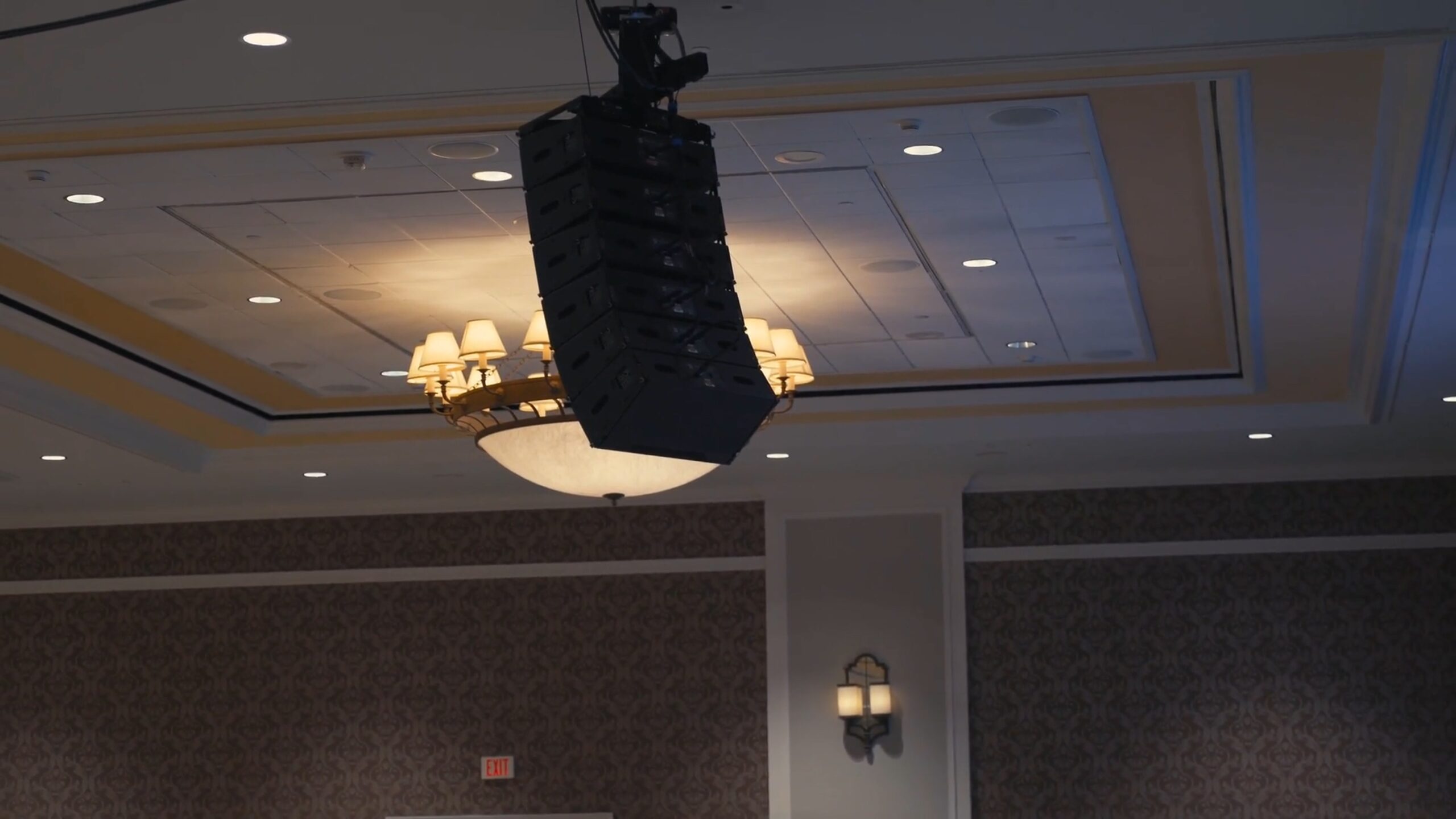
At stadium scale, JBL VTX V25-II deployments typically involve main hang configurations of 14–20 elements per side for primary coverage, with VTX A12 or F18 elements deployed as delays, downfills, and frontfills addressing the coverage zones that the main hang geometry cannot efficiently serve. The specific hang configuration—the number of elements, their inter-element splay angles, and the height and position of the rigging point—is derived from Performance Manager simulation using imported venue CAD geometry, then verified against measurement data from commissioning.
The HDI (High Definition Imaging) waveguide technology in the VTX series produces a measured improvement in vertical pattern control compared to VerTec-generation systems in exactly the frequency range—800Hz to 2.5kHz—where speech intelligibility and guitar presence are concentrated. In stadium deployments where the main hang is positioned at significant distance from the audience (15–20 metres above floor level is typical), maintaining consistent tonal balance across the vertical coverage range of the array is the difference between audio that sounds professional and audio that sounds technically correct but musically unsatisfying.
Crown I-Tech 12000HD amplifiers powering stadium VTX deployments operate at a thermal challenge level that requires active management. A 600-cabinet stadium deployment running through a 2.5-hour rock performance with substantial SPL time averaging above 110dB will drive the I-Tech units to the upper range of their thermal envelope during the final act of the show. Production companies that have learned from the 600-show curriculum pre-cool their amplifier racks through forced air ventilation starting 90 minutes before performance, reducing the initial thermal state from which the amplifiers begin their operational load cycle.
Global Stadium Diversity: Why Configuration Never Repeats
The 600-stadium curriculum is valuable precisely because no two stadium deployments are the same, and the experience of managing 600 different sets of variables builds the judgment that allows confident decision-making in unfamiliar situations. Wembley Stadium in London and Estadio Azteca in Mexico City are both large outdoor stadiums with roof structures and audience capacities above 70,000. The audio system requirements they impose are categorically different: Wembley’s roof creates a partial enclosure that generates specific low-frequency buildup requiring aggressive EQ treatment; Azteca’s altitude (2,240 metres above sea level) reduces air density in ways that affect both speaker efficiency and atmospheric absorption in ways that sea-level deployment experience doesn’t prepare engineers for.
The altitude effect on audio is one of the most underappreciated variables in international stadium touring. At 2,240 metres, air density is approximately 22% lower than at sea level, which reduces speaker SPL output by approximately 2.8dB at all frequencies—equivalent to requiring 90% more amplifier power to achieve the same level as at sea level. Production companies whose stadium systems are sized precisely for the output levels required at sea level will find themselves with insufficient headroom at high-altitude venues, a discovery that is better made during system design than during soundcheck 6 hours before the doors open.
Temperature extremes present their own stadium-specific challenges. The JBL VTX amplifier ecosystem—specifically Crown I-Tech HD amplifiers—operates within a rated temperature range of 0°C to 40°C. Outdoor stadium deployments in northern markets during spring and fall touring seasons regularly approach the lower end of this range during pre-dawn load-in operations, and the cold-start behavior of amplifier switching power supplies at near-freezing temperatures produces longer initialization times and temporary performance degradation that the production schedule must accommodate.
Signal Path Excellence at Stadium Scale
The signal path from the mixing console to the speaker transducer at a stadium VTX deployment involves more signal processing stages than any other production type, and the cumulative impact of each stage on the audio quality reaching the audience is proportionally larger at stadium scale where any tonal anomaly is reproduced across thousands of square metres of audience coverage.
The professional standard for stadium signal chains uses AES3 digital connections throughout: from the DiGiCo SD7 or Yamaha Rivage PM10 console to the system processor, from the system processor to the amplifier network via AES50 or Dante distribution. Maintaining the signal in the digital domain throughout the chain eliminates the cumulative noise floor degradation that multi-stage analogue conversion introduces in long signal chains, and provides the latency predictability that the time alignment of large delay systems requires.
JBL HiQnet Performance Manager’s amplifier monitoring capability becomes a practical necessity at stadium scale, where the inability to physically inspect every amplifier chassis during performance means that electronic monitoring is the only mechanism for early fault detection. The system’s real-time display of per-channel thermal states, output levels, and limiter activity allows the system engineer—stationed at a monitoring position separate from the FOH console—to identify developing problems before they become audible failures, enabling corrective action in the 2–5 minute window that typically precedes an amplifier protective shutdown.
Subwoofer Strategy for Stadium Scales
Stadium subwoofer deployment at the VTX S28 scale—the standard touring subwoofer choice for VTX-specifying production companies—involves cabinet counts that create logistics and structural engineering challenges alongside the acoustic design challenges. A stadium deployment using 48 JBL VTX S28 cabinets in cardioid configuration weighs approximately 4,200kg before rigging hardware, cabling, and the amplifier racks that power them. This load mass requires structural verification of the stage downstage edge where ground stacks are positioned—a verification that should be a pre-production engineering exercise, not a load-in-day calculation.
The cardioid configuration for VTX S28 at stadium scale uses a 3:1 forward-to-reverse ratio (36 forward, 12 reverse) that JBL’s application team has validated as the optimal balance between frontal output and rear attenuation for the cabinet’s specific low-frequency directivity characteristics. Alternative ratios—2:1, 4:1—produce different tradeoffs between these two parameters that may be preferable for specific site geometries, but should be evaluated through simulation and measurement rather than adopted on the basis of generic intuition.
The staging interface between the subwoofer array and the stage structure itself deserves more attention than it typically receives in production planning. Mechanical coupling between subwoofer cabinets and the stage floor—through which low-frequency energy can excite structural resonances in the stage, creating vibration that is felt by performers and transmitted through microphone stands to the audio signal chain—can be mitigated by decoupling pads between cabinet base plates and the stage surface. This simple intervention, costing less than €200 per cabinet in materials, eliminates a class of audio quality problems that are frequently misattributed to other causes.
The Production Manager’s Stadium Intelligence
For production managers responsible for JBL VTX systems at the 600-show experience level, the operational intelligence that the most challenging deployments generated is more valuable than the straightforward successes. The production that forced problem-solving under pressure—the amplifier failure 45 minutes before doors at a 60,000-capacity stadium, the rigging point that couldn’t be used because a pre-production structural assessment missed a load-bearing constraint, the DSP configuration file that didn’t load correctly from the backup drive and required manual reconstruction from notes—built the decision-making capability that defines operational excellence.
The business insight that consistently emerges from experienced production managers: pre-production investment has the highest ROI of any stadium audio expenditure category. The advance visits, structural engineering reviews, RF coordination sessions, and simulation-to-measurement verification exercises that add 15–20% to the pre-production budget reduce on-site problem-solving time by a substantially larger proportion, because they convert emergency problem-solving (expensive, high-pressure, error-prone) into scheduled problem-solving (efficient, methodical, documentable). Production companies that have internalized this ratio consistently outperform those that minimize pre-production investment and absorb the on-site cost consequences.
