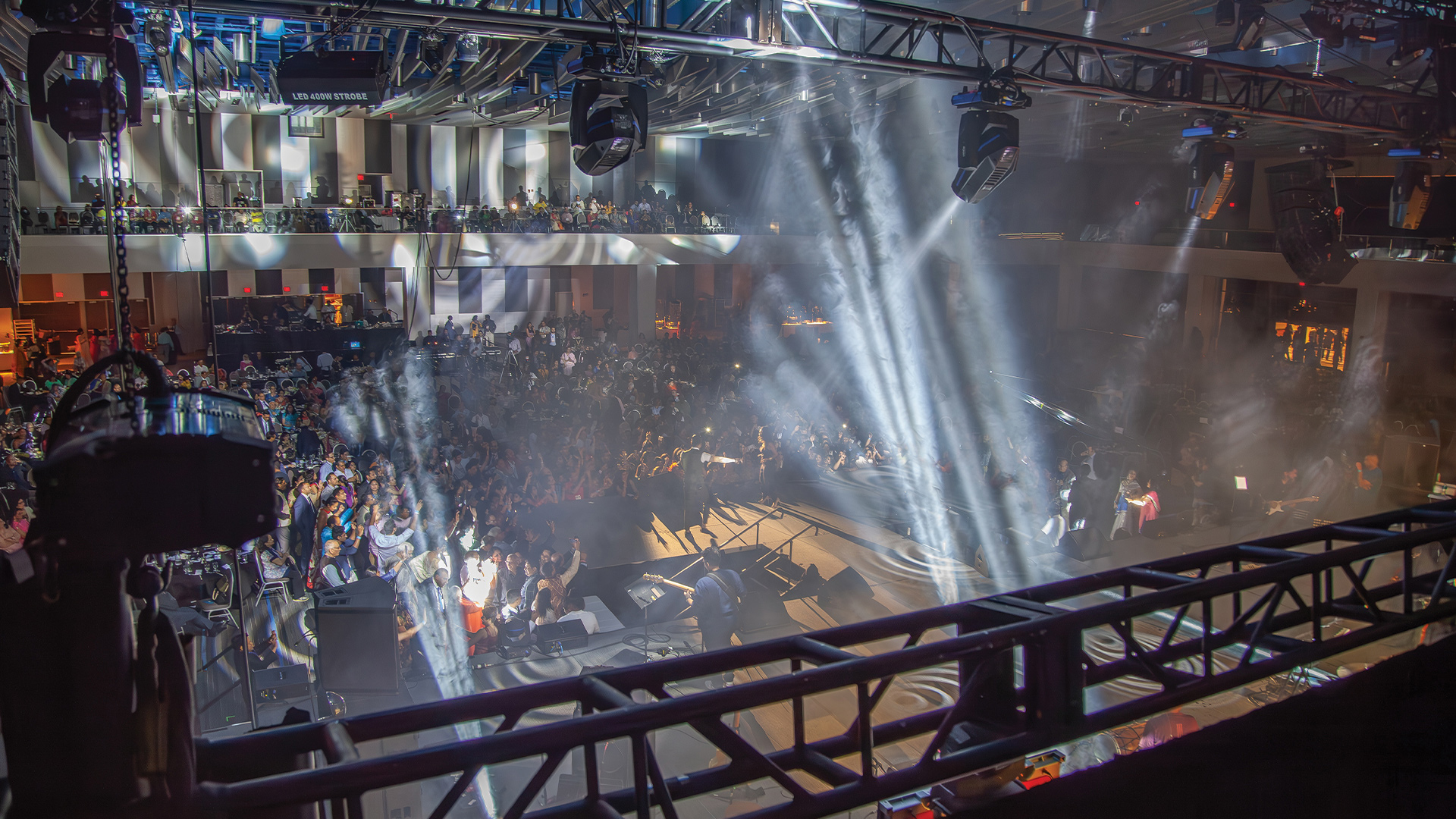
Running a wireless event in a major city is an exercise in frequency archaeology — excavating the usable spectrum from beneath layers of broadcast transmitters, mobile network infrastructure, government comms, adjacent event productions, and the ambient electromagnetic noise of dense urban infrastructure. A complete RF scan is not a five-minute pre-show ritual; it is a methodical engineering process that should begin days before the event and be repeated at key intervals as the radio environment evolves.
Why City RF Environments Are Uniquely Challenging
Urban RF environments are characterised by high noise floors across multiple bands, strong adjacent channel signals from broadcast transmitters, and unpredictable intermodulation products generated by the interaction of multiple strong signals. A location that appears clean during a Monday morning site survey may be saturated during a Friday evening event because a sports broadcast OB unit has deployed six vans of high-power transmitters within 500 metres of your venue.
The digital dividend reallocation — the progressive clearance of UHF bands 694-790 MHz for 4G and 5G mobile services — has dramatically compressed the available spectrum for wireless audio and intercom systems across Europe, Australia, and North America. What was once a usable band for Shure ULXD or Sennheiser 2000 Series systems may now carry LTE Band 28 mobile traffic that creates persistent interference across the band.
Equipment for a Professional RF Scan
A professional RF scan requires a calibrated spectrum analyser with sufficient sensitivity and sweep speed to capture transient signal activity. The Rohde & Schwarz PR100 is the instrument of choice for broadcast and production RF coordination, offering 9 kHz to 7.5 GHz coverage with -150 dBm noise floor. For production teams without access to this level of equipment, the RF Explorer spectrum analyser combined with VANTAGE software by Professional Wireless Systems provides a capable and more affordable alternative.
Frequency Coordination Software
Any production with a 12-channel or larger wireless system requires dedicated frequency coordination software. Wireless Workbench 6 by Shure and Intermodulation Analysis System (IAS) by Professional Wireless Systems are the two dominant tools. Both calculate intermodulation products and identify frequency sets with no spurious signals falling on active channels. The Shure Wireless Workbench scans should be imported from real spectrum measurements rather than generated from theoretical models.
Timing the Scan Correctly
A comprehensive scan protocol for a major city event should include: an initial survey scan 48 hours before the event to establish the static interference landscape, a day-of-event scan at the time corresponding to the show (a 7pm show should be scanned at 7pm on the preceding evening), and a final scan one hour before the first wireless transmission goes live. The day-of-event scan is particularly important for venues near sports stadia, conference centres, or hotel complexes that regularly host large events.
Documentation and Contingency Planning
The output of the RF coordination process is a frequency assignment document — a table listing every transmitter in the system with its assigned frequency, power level, and antenna position. Every production should also identify a contingency frequency bank — a set of pre-calculated clean frequencies ready to substitute if a channel becomes unusable during the show. The Shure Axient Digital and Sennheiser Digital 6000 platforms both support ShowLink and Advanced Frequency Management respectively — remote frequency scanning and switching capabilities that allow RF engineers to respond to interference events without physical access to the transmitter pack.
