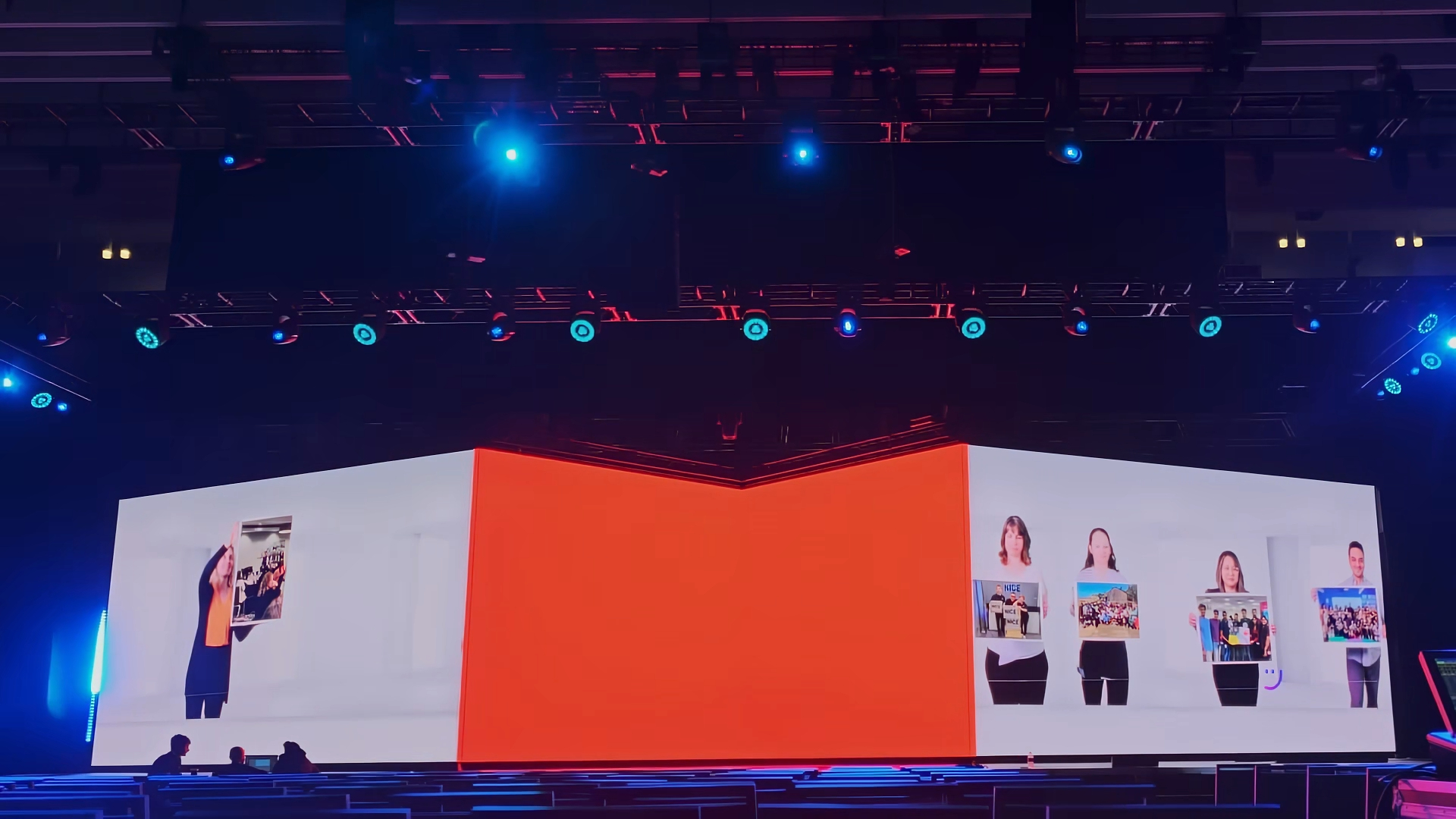
For most of the live event industry’s history, the audience that mattered was the one physically present. The streaming audience was secondary—a broadcast afterthought, a marketing distribution channel for the brand, a documentation exercise for the archive. The shift that has occurred over the past five years is not incremental. It is categorical: for an increasing number of productions, the online audience outnumbers the physical audience by orders of magnitude, and the LED wall installations that historically served the room now primarily serve the frame.
The 2 million online viewer threshold—reached by corporate events, product launches, concert streams, and hybrid conference productions from brands including Apple, Tesla, Salesforce, and Nike—defines a production tier where the LED wall’s camera-facing performance is the primary design brief, not a secondary consideration accommodated within a design built for live audience impact. Productions at this scale deploy LED walls as virtual production backdrops, as brand identity environments, and as narrative architecture—functional elements whose performance is evaluated in the browser and the broadcast monitor as much as in the venue.
Camera-First LED Design: The Technical Discipline
Designing an LED wall for a production reaching 2 million online viewers requires a fundamentally different technical discipline than designing for a live audience. The live audience perceives the wall through human vision—with its adaptive exposure range, spatial integration, and motion blur characteristics. The camera perceives it through an electronic sensor with fixed exposure settings, a specific shutter angle, and a pixel resolution that interacts with the LED wall’s pixel pitch in ways the human eye never would.
The moiré patterning problem—where the regular pixel grid of the LED wall interferes with the camera sensor’s pixel array to create rolling interference patterns in the captured image—is the first camera-LED interaction challenge that production designers encounter. Resolving it requires camera testing: deploying the actual cameras planned for the production at their intended positions and distances, shooting at the planned shutter angle and exposure settings, and evaluating the captured footage for moiré patterns with each candidate pixel pitch option. No simulation tool reliably predicts moiré behavior across all camera-distance-pitch combinations; empirical testing is mandatory.
LED wall brightness calibration for camera-facing use is expressed differently than for live audience use. Rather than candelas per square metre—the measurement relevant to human perception—camera-facing LED walls are calibrated to stops of exposure relative to the foreground lighting. A wall that is 1.5 stops brighter than the key light on the presenter creates a blown-out background in the camera frame; a wall that is 2 stops darker creates a background that appears black in the broadcast image. The target is typically 0.5–1 stop above key light brightness—bright enough to read detail and color in the captured image, not so bright that it competes with the foreground subject.
Content Strategy for Global Streaming Audiences
Content created for LED wall installations serving 2 million global online viewers occupies a different creative space than content created for live audience impact. The theatrical content strategies that work in a 3,000-seat venue—kinetic, high-contrast, saturated—frequently appear aggressive and visually fatiguing when viewed through compressed video streaming, where the encoding algorithms that make streaming commercially viable also reduce the apparent sharpness and tonal precision of high-motion content.
Notch and Resolume Avenue content—the two platforms most commonly used for real-time generative LED wall content in corporate and hybrid event production—both offer rendering parameters optimized for camera capture rather than direct viewing. Reducing motion velocity, increasing spatial frequency content scale, and targeting a tonal range of 16–235 in an 8-bit signal (the “legal broadcast range” that prevents luma clipping in video encoding) are the content adjustments that translate visually compelling live content into broadcast-quality camera-facing material.
The brand color accuracy challenge at streaming scale is particularly important for corporate productions where the LED wall serves as a brand identity environment. A company’s brand colors—specified precisely in Pantone or RAL references—will be reproduced with varying accuracy through the chain of LED wall output, camera capture, streaming encoding, and display rendering. Achieving acceptable brand color accuracy at the audience’s screen requires color pipeline management from the LED processor through to the streaming encoder—a technical workflow that requires coordination between the LED technical director, the broadcast director of photography, and the streaming production team that most corporate events don’t treat as a unified responsibility until a brand manager complains about it in post-event review.
Infrastructure for 2 Million Concurrent Streams
The LED wall production for an event reaching 2 million concurrent online viewers sits at the intersection of two production disciplines—live event and broadcast—whose technical requirements are distinct and whose organizational cultures are frequently in tension. Live event production prioritizes flexibility and rapid problem-solving; broadcast production prioritizes systematic process and documented standards. Productions that reach the 2 million viewer tier typically succeed because they resolve this tension by establishing clear technical authority at each interface point rather than allowing the two disciplines to negotiate informally.
The Disguise media server platform has become the most common bridge between these disciplines because its architecture explicitly supports both live event content operation and broadcast output routing. Disguise’s multi-output architecture—capable of simultaneously driving the physical LED wall and providing clean video outputs for broadcast capture—with the calibration workflows that ensure color consistency between the LED wall’s physical appearance and the broadcast output signal, addresses the core technical integration challenge that productions at streaming scale must solve.
Redundancy architecture for a production reaching 2 million viewers must be specified at a standard higher than for single-venue live events. A media server failure during a 3,000-capacity live event is embarrassing and costly. The same failure during an event with 2 million global concurrent viewers is a major brand incident. Hot-standby Disguise systems—a second gx 2c or gx 3c unit mirroring the primary system in real time, ready to assume output control within seconds—represent the minimum redundancy standard for productions at this viewer threshold.
Case Studies Across the 2M+ Viewer Tier
The LED wall productions that have reliably crossed the 2 million online viewer threshold share a production philosophy that is instructive regardless of the specific brand or event involved. The shared characteristic is pre-production investment in camera testing and content optimization that would be considered excessive by production standards focused solely on the live audience. These productions budget specifically for camera test sessions—bringing the broadcast camera team, the LED wall rental, and the content team together 3–5 days before the event to validate the complete visual system under production conditions before the audience and the brand stakes are live.
Salesforce Dreamforce’s production at the Moscone Center in San Francisco—consistently reaching audiences of 1.5–2.5 million global livestream viewers—has standardized on a pre-production workflow that includes a dedicated camera/LED compatibility session 72 hours before the event, where every content sequence planned for the LED wall is shot with the actual broadcast cameras at the actual focal distances planned for the event. Sequences that produce moiré, exposure problems, or brand color inaccuracy are revised before they are ever seen live.
The commercial model for these productions—where the streaming audience’s experience is treated as commercially equivalent to the physical audience’s—reflects a genuine market evolution. Brands are allocating production budgets that reflect the streaming audience’s size, not the physical audience’s size. Productions that serve the live audience excellently but the streaming audience adequately are leaving commercial value on the table by failing to invest proportionally in the camera-facing technical discipline that the larger audience requires.
Technical Specifications for Broadcast-Quality LED Walls
For production professionals specifying LED walls for broadcast-quality streaming applications, the technical specification requirements differ materially from those for live-audience applications. Pixel pitch selection for streaming applications should prioritize the camera-to-wall distance relationship over raw image quality: a 2.6mm pixel pitch wall at 6 metres camera distance may produce moiré issues with specific camera-lens combinations that a 1.9mm pitch wall at the same distance eliminates—but the 1.9mm wall at 3 metres with a long focal-length lens may produce worse moiré than the 2.6mm wall. Camera testing across the planned focal lengths and distances is the only reliable specification tool.
Refresh rate matters for broadcast in ways it doesn’t for live viewing. LED walls with refresh rates below 1,920Hz can produce visible banding in broadcast images captured at 1/50 or 1/60 second shutter speeds—a problem invisible to the human eye but immediately apparent in the broadcast monitor. ROE Visual, Absen, and Unilumin all produce panels with refresh rates of 3,840Hz or higher in their broadcast-grade product lines; specifying panels from these high-refresh product families eliminates banding as a production variable.
Brompton Technology’s Tessera processing—the LED processing platform of choice for broadcast-critical applications—provides the per-panel calibration and color management workflow that ensures the LED wall’s measured output matches the intended signal. The Brompton Dynamic Calibration system’s closed-loop measurement capability—where the system measures the actual output of each panel using a colorimeter and applies correction curves that bring all panels to a common color and brightness reference—is not optional for productions where brand color accuracy across 2 million viewers’ screens is a commercial requirement.
