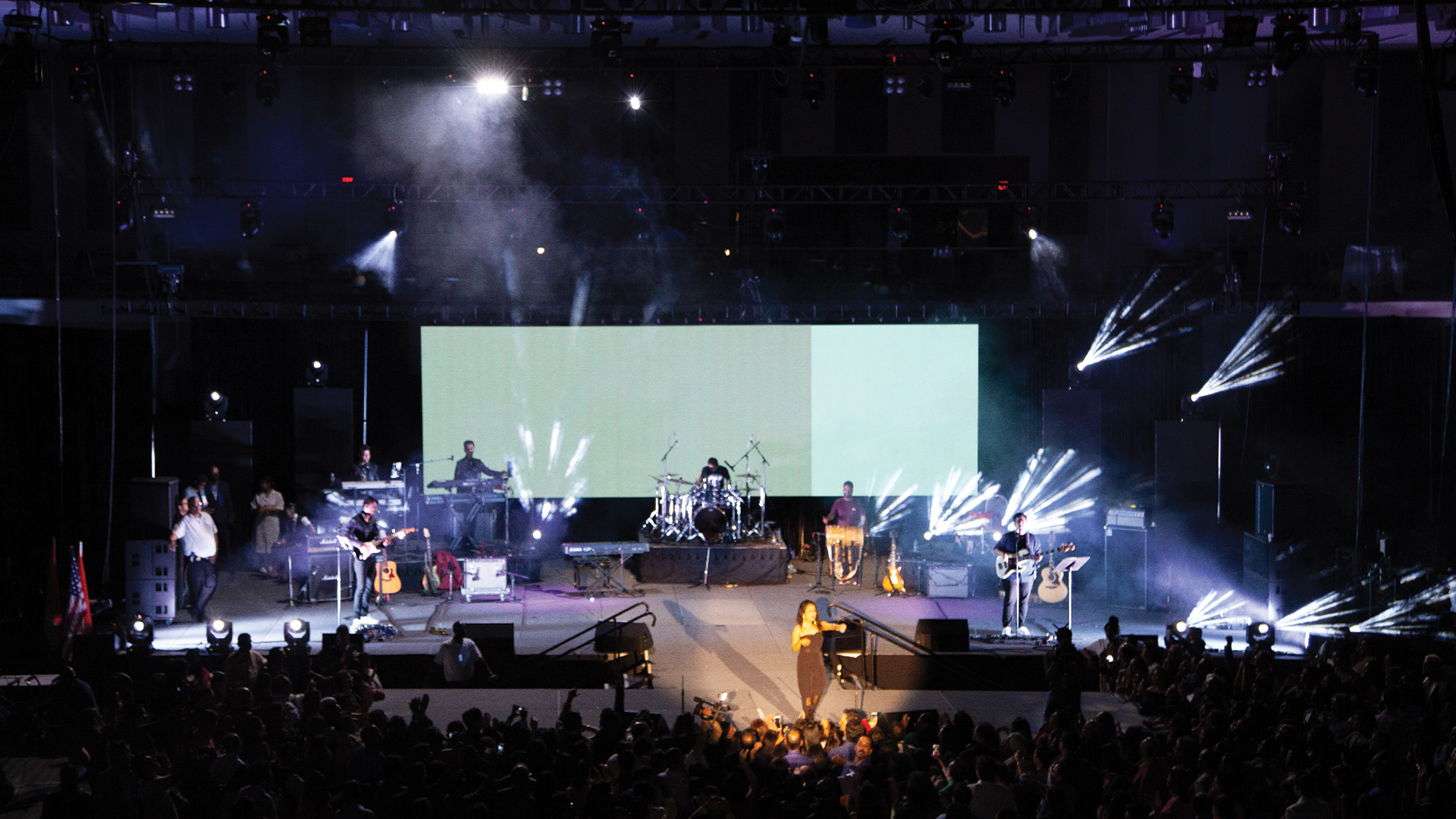
The pop-up concert — a live performance executed in a location not designed for live music, often with minimal advance notice and maximum creative ambition — is one of the most demanding tests of an event production team’s versatility. The location might be a rooftop, a retail space, a railway arch, a parking structure, a public square, or a wilderness landscape. What these locations share is an absence of the infrastructure that conventional concert production takes for granted: no power distribution panels, no rigging points, no DMX pathways, no dedicated electrical circuits for production equipment. Into this infrastructure vacuum, Astera’s wireless LED ecosystem has inserted itself as the enabling technology that makes professional-quality lighting production achievable in any location — not as a compromise, but as a genuine creative tool whose wireless-native design is actually advantageous in unconventional settings.
The cultural appetite for pop-up concert experiences has its roots in the guerrilla performance traditions of the early 2000s — flash mobs, unexpected street performances, and the nascent secret show circuit that bands like Radiohead and LCD Soundsystem used to generate buzz before album releases. What transformed the format from an occasional stunt into a legitimate production category was the convergence of social media distribution and battery-powered production technology that allowed these events to be captured and shared instantly — making the audience of a 300-person rooftop show effectively unlimited.
Astera AX1, Titan Tube, and the Infrastructure-Free Light Rig
A complete Astera wireless lighting system for a pop-up concert might consist of 40 Titan Tubes, 20 AX1 PixelTubes, 12 Astera Helios fixtures, and a single AsteraBox wireless transmitter — powered by a Honda EU32i generator or a Jackery Explorer battery system that itself requires no permanent power connection. The entire system fits in a 3/4-ton van, can be unloaded and operational in under two hours with a crew of four, and creates a professional lighting environment indistinguishable in visual quality from a conventional cabled production in a purpose-built venue. This is not an aspiration — it is the documented operational reality of pop-up productions executed by companies including LD Systems, Sound Moves, and Red Eye Events who have built specialist Astera-based pop-up production packages as a distinct service offering.
The AsteraApp control workflow is ideally suited to the pop-up format’s demand for rapid deployment and real-time adaptation. A single lighting director working from a tablet can address all 72 fixtures in the above rig in under 20 minutes, assigning groups, cue scenes, and color palettes through the app’s intuitive interface. For more complex programming requirements, the system transitions seamlessly to grandMA3 or Chamsys MagicQ control via Art-Net from the same tablet WiFi hotspot — allowing the pop-up’s lighting programmer to apply the same cue-based workflow used in arena productions to a rooftop with 40 wireless fixtures.
Power Independence: The Generator and Battery Revolution
The second enabling technology behind the pop-up concert revolution is the dramatic improvement in portable power quality and density. Honda EU22i generators — whisper-quiet, inverter-based generators producing stable, low-THD sine wave power — have been the standard portable power source for production in locations without shore power for over a decade. More recently, industrial battery storage systems from manufacturers including EcoFlow DELTA Pro and Bluetti have reached power densities sufficient to run Astera lighting systems for 4–6 hours without a generator — enabling truly silent pop-up productions in locations where even a quiet generator would be prohibited, such as heritage sites, residential environments, or indoor spaces with strict noise regulations.
The combination of Astera’s battery-independent fixtures (each running on internal cells) and an external battery power system for the console, transmitter, and any supplementary equipment has created what production professionals call the dark rider — a complete production package that leaves no power infrastructure footprint on the host location. For brands executing activations in protected environments — a luxury brand filming a product reveal in a national park, a streaming platform capturing an artist performance in a museum after hours — this power independence is not a nice-to-have but a contractual requirement of the location permit.
Broadcast-Quality Pop-Up: The Social Media Imperative
The pop-up concert in 2024 is almost always a broadcast production. The physical audience of 200 people is the live element; the Instagram audience of 200,000 is the actual target. This broadcast imperative places Astera wireless fixtures in the role of both scenic lighting and broadcast lighting simultaneously — a dual function that their high CRI color rendering (95+ CRI on the Titan Tube) and broadcast-calibrated brightness levels make genuinely feasible. Camera operators shooting on Sony FX9 or Canon C300 capture Astera-lit environments with the color accuracy and dynamic range that social and streaming platforms require, without the overexposure issues that afflict less carefully specified wireless LED products.
The pop-up concert enabled by Astera wireless technology represents a democratization of production quality that is reshaping the relationship between live performance and its audiences. The infrastructure barrier that once restricted professional-quality lighting to purpose-built venues has dissolved. The concert can happen anywhere — and with the right Astera kit and the right crew, it will look extraordinary when it does.
