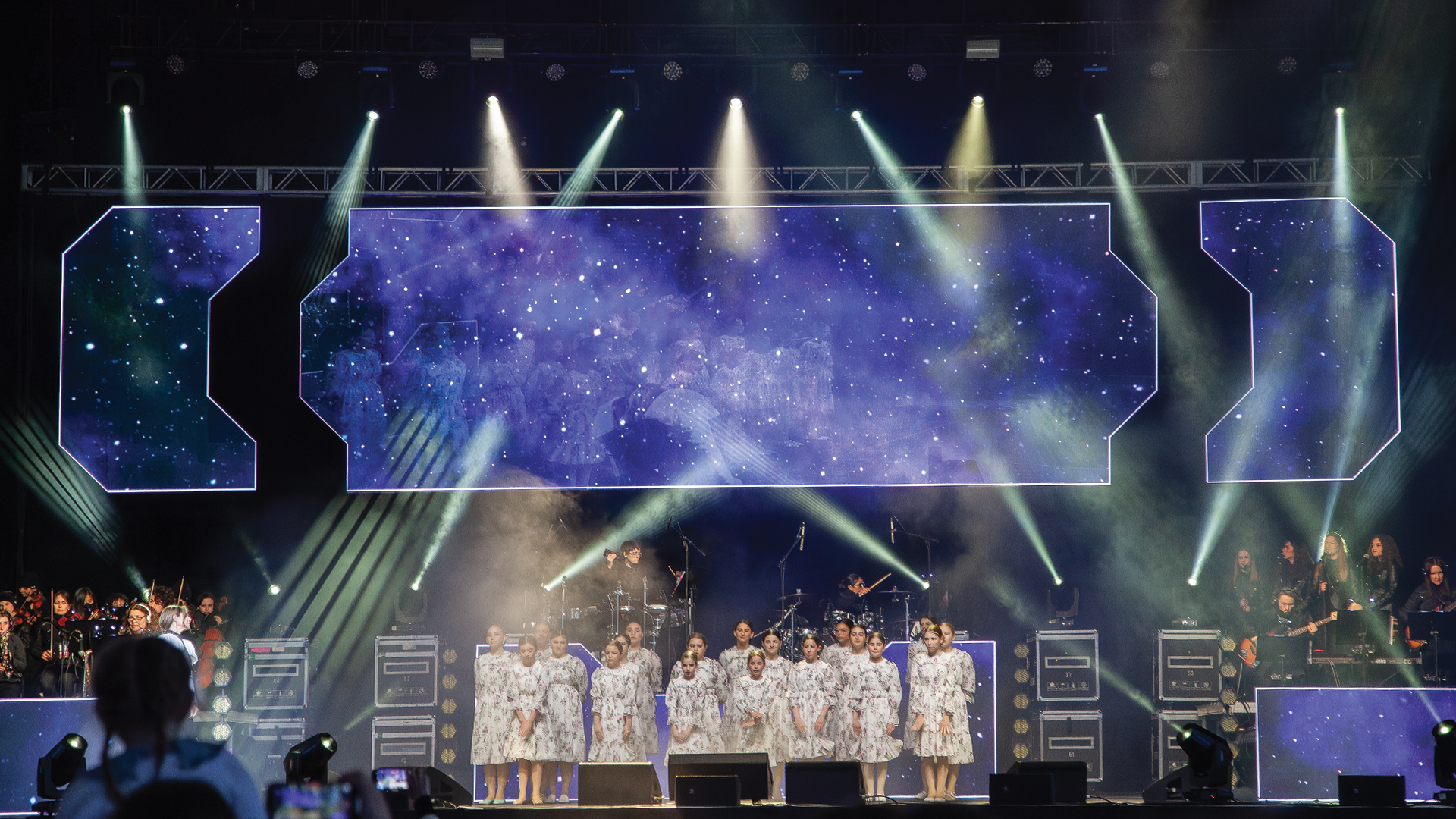
The ambition to deliver a live event simultaneously to a physical audience and a global streaming audience spread across 50+ countries is not a technical challenge in the conventional sense — it is an architectural challenge. The LED wall system, the content delivery infrastructure, the broadcast encoding pipeline, and the streaming CDN must be designed as a unified system from the outset, with each component aware of the requirements it places on every other. Productions that treat these as separate domains — physical event on one side, streaming on the other — consistently produce results that satisfy neither audience fully. The productions that have mastered this dual-audience problem are, without exception, the ones that designed the LED wall for the stream first.
Latency, Colour Space, and the Broadcast-LED Gap
Three technical challenges define the gap between a LED wall designed for physical audiences and one that serves global streaming. Latency: LED walls with scan rates below 3,840 Hz produce visible frame lines when captured on broadcast cameras operating at standard frame rates, creating the moiré artifacts that mark amateur hybrid productions. Colour space: LED panels operating in wide colour gamut modes produce colours that exceed the BT.709 colour space of standard broadcast delivery, resulting in colour clipping that makes the streamed image look washed out compared to the physical LED wall’s vivid palette. Brightness: LED walls calibrated for a physical venue’s ambient light conditions may be 3-5 stops above broadcast-legal levels, requiring the camera to stop down and lose the depth-of-field characteristics that make close-up broadcast footage visually compelling.
The Brompton Technology Tessera SX40 processor — widely regarded as the broadcast-grade LED processing standard in touring production — addresses all three simultaneously. Its 4K processing capability handles up to 40 million pixels at 24-bit colour depth, its refresh rates of 3,840Hz to 7,680Hz eliminate broadcast camera artifacts, and its HDR mode allows operators to set different brightness and colour space profiles for physical wall output versus a dedicated broadcast output feed that is pre-graded for BT.2020 HDR delivery. The result is a single LED wall system that simultaneously serves both audiences without compromise.
Content Delivery Architecture for 50-Country Distribution
Distributing live event streams to 50+ countries with consistent quality requires a CDN (Content Delivery Network) architecture that differs significantly from conventional video streaming. Simultaneous access events — where a significant fraction of the total audience connects within minutes of each other — create bandwidth demand spikes that overwhelm single-origin streaming architectures. Major tours and events use multi-CDN strategies combining Akamai, Cloudflare, and Fastly edge networks to ensure that audience members in Jakarta, Buenos Aires, and Oslo receive the same stream quality without buffering regardless of their proximity to the streaming origin server.
The video encoding pipeline that feeds these CDN networks is itself a complex system. High-quality live streams for 4K HDR delivery use HEVC (H.265) encoding at 25-40 Mbps, typically processed through hardware encoders from Harmonic or Grass Valley that are rack-mounted in the production infrastructure and fed via fibre from the broadcast camera mix. The choice of encoding parameters — including GOP structure, bitrate ladder for adaptive streaming, and HDR metadata packaging — determines the quality of the stream received by 2 million simultaneous viewers in 50 countries. These are not decisions made by the touring crew — they require a dedicated broadcast technical team embedded in the production from design stage.
ROE Visual and Absen: The LED Products Built for Global Streaming
Not every LED manufacturer has addressed the hybrid streaming market with equal seriousness. ROE Visual and Absen stand apart for having built entire product lines around broadcast-hybrid requirements. ROE Visual’s Ruby RB1.9B — a 1.9mm pitch panel in a blackbody housing that minimises camera lens flare — was engineered specifically for broadcast-facing applications including virtual production, xR stage work, and hybrid live events. Its Brompton Tessera integration is certified by both manufacturers, ensuring that the colour calibration data embedded in each panel’s firmware is correctly interpreted by the processor.
Absen’s PL2.9 Pro panel, introduced in 2022, brought extended black mask design to touring-grade hardware — a feature borrowed from the broadcast virtual production world where contrast ratio between LED chips matters as much as peak brightness. On a 4K broadcast feed showing a close-up of an artist against a dark LED background, the ratio between the brightest and darkest pixel in the frame determines whether the background reads as a professional broadcast surface or a consumer LED screen. The PL2.9 Pro’s 9,000:1 contrast ratio makes this distinction unambiguous.
Virtual Production Crossover: When Touring Meets the Volume
The most technically sophisticated productions serving 50+ country streaming audiences are increasingly borrowing techniques from the virtual production world — specifically from the LED Volume environments pioneered by Industrial Light & Magic for the Disney+ series The Mandalorian. In these setups, the LED wall is not just a scenic backdrop — it is a real-time rendering environment fed by Unreal Engine or similar game engine platforms that respond to camera position and lens data, maintaining correct perspective as the camera moves through the space.
Touring productions have adapted this technology for hybrid events where the broadcast experience needs to feel distinctly different from simply watching the live show. The Disguise vx4+ media server and Notch Builder real-time effects platform are the tools most frequently deployed in this context, allowing production designers to create camera-reactive visual environments that make the streaming experience genuinely immersive rather than a passive observation of physical events. For 2 million viewers across 50 countries, this transformation in broadcast quality is the difference between an event they watch once and one they replay, share, and define their relationship to the artist through. The LED wall has become the most powerful marketing medium in the music industry. Engineering it for the stream is no longer optional — it is the measure of professional ambition.
